Loading...
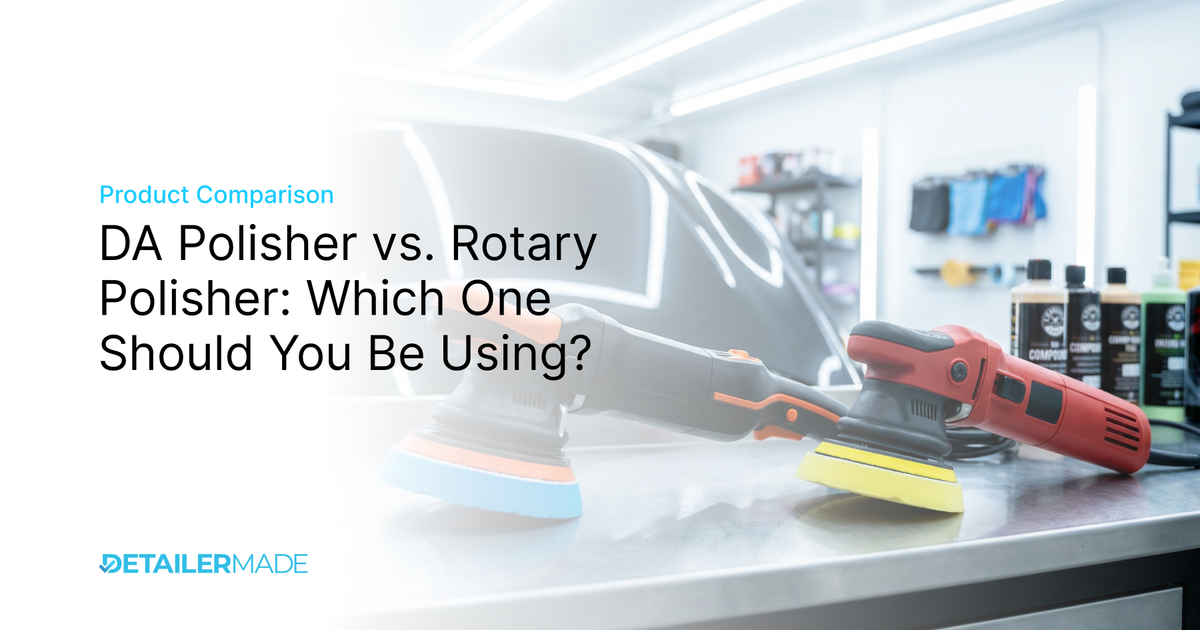
DA Polisher vs. Rotary Polisher: Which One Should You Be Using?
JD
Detailermade Team
DA or rotary — it's one of the most common questions among detailers at every level. The answer isn't one or the other. It's knowing what each machine does, where each one excels, and when to reach for which. Most professional shops run both. This guide explains why.
How Each Machine Moves
A dual-action (DA) polisher moves in two simultaneous motions: the pad rotates around a central axis and also oscillates in an eccentric orbit. The free-spinning head means the pad can slow or stop its rotation when it encounters resistance, limiting heat buildup. The orbital pattern distributes abrasive work across a larger area, making the cutting pattern less aggressive per square inch.
A rotary polisher moves in one direction: the pad spins in a fixed rotation around a central axis. No oscillation. All the energy goes directly into the contact patch. The pad maintains speed under load. This generates more heat, more cutting power, and significantly more risk in the wrong hands.
Cutting Power
Rotary wins on raw cutting power. On hard paint — German manufacturers, hard domestic clear coats, some older vehicles — a rotary with a compound and cutting pad corrects in a fraction of the time a DA requires. It cuts deeper, faster, and more efficiently on resistant paint.
Modern DAs have closed the gap significantly. A Rupes LHR21 Mark III or Flex XFE 15-150 paired with a microfiber cutting disc and M105 handles correction that used to require a rotary on most paint types. On soft to medium-hardness paint, a quality DA with the right setup delivers serious cutting power with far less risk. The remaining gap is on genuinely hard paint where maximum cutting efficiency matters — heavy correction on a Porsche or M3 clear coat.
Heat and Paint Risk
The DA's safety advantage is the free-spinning pad that slows under resistance. Heat stays manageable and it's much harder to burn paint, especially on body lines and edges. An operator making a mistake on a DA usually makes a minor one.
A rotary maintains pad speed under load. Heat builds quickly when the operator slows down, applies extra pressure, or works an area repeatedly. Paint burning on edges and sharp body lines is not a matter of "if" with a rotary — it's a matter of operator skill and attention. Rotary work requires conscious heat management on every panel.
For operators learning correction: DA. The learning curve is a fraction of what a rotary requires and the margin for error is substantially wider. For experienced operators: the rotary is a legitimate tool for specific high-demand correction, but it earns respect on every job.
Pad Selection
DA pads: • Microfiber cutting disc (Meguiar's DHCD, Rupes Coarse MF): maximizes DA cutting, best for correction-level work • Foam cutting pad: moderate, controlled cutting • Foam polishing/finishing pad: refinement and light correction • Microfiber finishing disc: excellent final finish before coating application
Rotary pads: • Heavy wool or foam cutting pad: aggressive cutting on hard paint • Medium foam: moderate correction • Foam finishing pad: final refinement (requires heat management discipline)
Machine Recommendations
DA polishers: • Rupes LHR21 Mark III — 21mm throw, excellent ergonomics and cutting ability. The professional benchmark. • Flex XFE 15-150 — strong competitor to the Rupes, very reliable, slightly more aggressive throw • Griot's Garage G9 — 21mm throw, excellent performance at a lower price point • Milwaukee M18 Forced Rotation — cordless convenience for finishing and maintenance polish, not a primary correction machine
Rotary polishers: • Flex PE14-2-150 — the professional standard. Reliable, variable speed, excellent torque control. • Rupes LHR75E in rotary mode — excellent for heavy correction • Milwaukee M18 Rotary — cordless rotary that's changed accessibility, though not a substitute for a corded unit on heavy correction work
The Honest Recommendation
Starting out: buy a quality DA first. It handles single-stage and two-stage correction on the majority of vehicles you'll encounter, without the risk of burning paint while you're developing technique.
Expanding your kit: add a rotary once you have consistent, confident DA technique. The rotary pays dividends on hard paint, heavy correction, and high-volume production work. Not every job needs it, but when you need it, nothing replaces the efficiency.
In a professional shop setup, the DA handles the majority of correction and all finishing. The rotary comes out for heavy cutting on hard paint and initial correction passes where time efficiency on resistant clear coat matters. Both machines, used where they're best suited, produce better results than either one alone.