Loading...
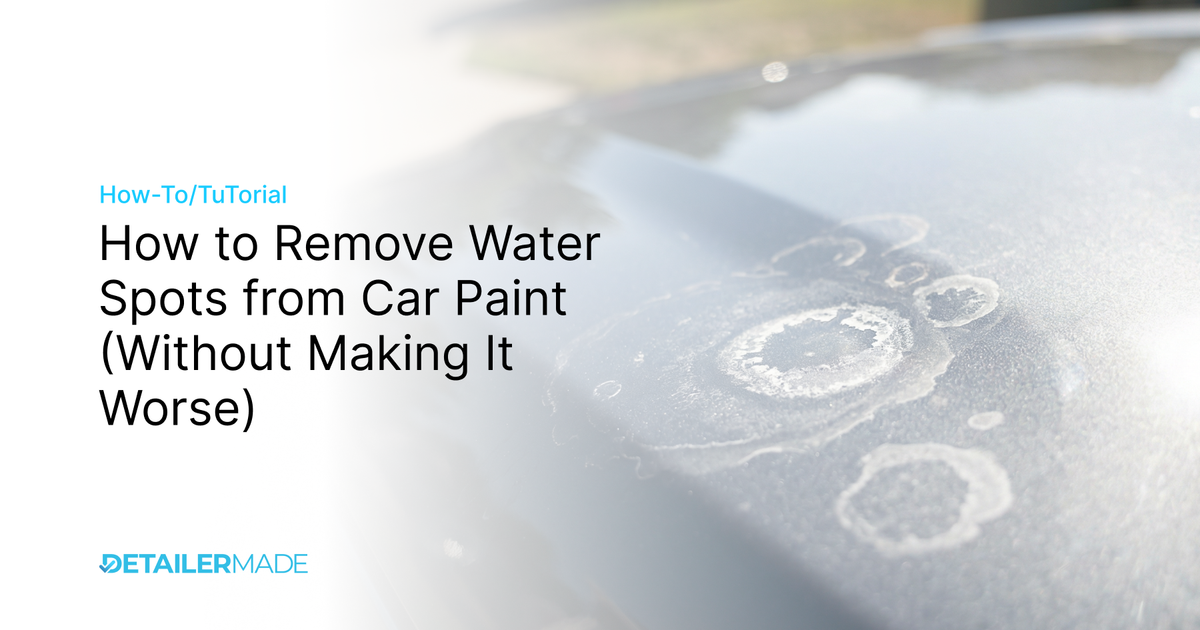
How to Remove Water Spots from Car Paint (Without Making It Worse)
JD
Detailermade Team
Water spots are one of the most common complaints detailers deal with, and one of the most mishandled. The instinct is to grab a microfiber and wipe. That's usually wrong. This guide covers the three types of water spots, how to tell them apart, and how to remove each one without turning a recoverable problem into a correction job.
What Water Spots Actually Are
Water spots form when water evaporates and leaves behind the dissolved minerals it was carrying — calcium, magnesium, silica, and other compounds present in tap water, well water, and irrigation runoff. The concentration of those minerals in the water, combined with heat and UV exposure, determines how severe the spots become after evaporation.
Heat makes everything worse. Water sitting on a dark car in direct summer sun evaporates faster, concentrates minerals more aggressively, and bonds to the surface more quickly. A single sprinkler hit on a black car parked in a hot driveway can leave spots that require polishing to remove. Catching it early makes an enormous difference in how difficult the removal process is.
The Three Types of Water Spots
Not all water spots are the same, and the removal approach changes significantly based on which type you're dealing with.
Type 1 — Surface mineral deposits: Minerals sitting on top of the paint or coating surface, not yet bonded into it. These are fresh spots — white or milky looking, haven't had time to etch or harden. The easiest to address and the most commonly over-treated.
Type 2 — Bonded deposits: Minerals that have had time and heat to bond to the clear coat surface. More defined edges, harder texture. Wiping alone doesn't touch them. They require chemical removal with proper dwell time, and sometimes clay afterward to lift the softened residue.
Type 3 — Etched spots: The minerals — or more commonly, acid rain with dissolved pollutants — have chemically reacted with the clear coat surface itself. The surface has been physically altered. These feel smooth to the touch (no raised deposit) but the defect is still visible because the surface is no longer optically flat. Removing them requires abrasive polishing. In severe cases, the etching is permanent.
Quick field test: drag your fingernail lightly across the spot. Feel a raised deposit or gritty texture? Type 1 or 2. Surface feels smooth but the defect is still visible? Type 3, and you're looking at a correction job, not a chemical removal job.
Removing Type 1: Fresh Surface Deposits
Fresh, surface-level deposits respond well to a quick chemical treatment. Products like Gyeon Q2M Water Spot, Chemical Guys Water Spot Remover, or CarPro Spotless are formulated for this. Apply to the affected area, let dwell 30–60 seconds, and wipe with a clean microfiber. The acidic or chelating chemistry dissolves mineral deposits without mechanical action.
Diluted white vinegar (pH around 2.4) also works on Type 1 spots. Apply to a microfiber and dab — don't rub — onto the spot, let sit 30–60 seconds, then rinse thoroughly. Don't let it sit long on bare paint or ceramic coatings. Rinse fully when done and follow up with a quick detailer or coating booster to restore protection on the treated area.
Removing Type 2: Bonded Deposits
Bonded deposits that don't respond to a quick treatment need more dwell time, a stronger product, or both. Apply your water spot remover and let it work 2–3 minutes. Covering the treated area with a damp microfiber during dwell prevents evaporation and extends working time. Work in the shade on cool paint — heat causes the chemical to flash before it's done working.
If chemicals alone aren't fully removing the deposit, follow up with clay. After chemical treatment softens the bonded minerals, a clay bar or mitt pass can physically lift what the chemistry dissolved but didn't remove. Use generous clay lubricant and light pressure. Don't clay a dry or barely-lubricated surface.
Type 2 spots that still won't budge after extended chemical dwell and clay should be treated as Type 3 and approached with light polishing.
Removing Type 3: Etched Clear Coat
Etching is a paint correction problem. The surface has been chemically altered and needs to be leveled with abrasives. Start conservative and work up only as needed:
Light polishing first: Meguiar's M205 or Rupes Uno Pure on a foam finishing pad with a DA polisher handles light etching that hasn't gone deep into the clear coat. Run a test spot, assess, then commit to the panel.
Step up to compound if needed: If finishing polish alone isn't removing the etch, move to a light compound on a light cutting pad (M105, or Koch Chemie H8.02). Don't skip to heavy compound unless the test spot tells you it's necessary. You're removing material that doesn't grow back.
Know when to stop: If compounding isn't removing the etch, check your paint depth gauge. The etching may be deeper than safe polishing can address without cutting through the clear coat. At this point the conversation with the client is about managing expectations, not about product selection.
After any correction, protect the surface immediately. Corrected paint that sits bare will re-spot faster than it did before. Apply a coating, sealant, or wax to create a sacrificial layer above the clear coat.
Preventing Water Spots
Don't let water dry on the paint: rinse and dry immediately after washing. Use a forced-air blower (Metrovac Air Force Blaster or similar) to evacuate water from mirrors, trim gaps, and bodywork seams before drying with a microfiber. Water that hides in crevices and drips out 10 minutes later creates spots on a car you just dried.
Coating protection helps significantly. A hydrophobic ceramic coating or sealant causes water to sheet off rather than pool and evaporate. It doesn't eliminate spotting entirely, but dramatically reduces it and makes removal much easier when spots do occur.
Ask clients about irrigation. A surprising number of water spot problems trace directly to a sprinkler head hitting the car overnight. It's worth asking during intake, especially on vehicles with recurring spot issues that don't fit weather patterns.
Quoting Water Spot Removal
Type 1 and 2 removal is typically an add-on to a maintenance detail — $25–$75 depending on severity and coverage area. Type 3 etching that requires paint correction should be quoted as a correction job. The scope of work is entirely different and the pricing has to reflect it.
Document spots at intake with photos. If some Type 3 etching can't be fully corrected, that documentation is your protection when the client notices spots are still visible after the job. Never start a water spot job without establishing in writing which spots are recoverable and which may not be.