Loading...
How to Start a Mobile Auto Detailing Business: The Complete 2026 Guide
JD
Detailermade Team
Mobile detailing is one of the lower-barrier business models in the service industry. No shop lease, no commercial infrastructure, and a market that's only grown for at-home vehicle care. But "lower barrier" doesn't mean "no barrier" — and the detailers who build real businesses treat this like a real business from day one. This guide covers what you actually need, what it costs, and what the common first-year mistakes look like.
The Real Trade-Off of Going Mobile
The advantage is obvious: no fixed overhead. A shop lease exists whether you're busy or not. Mobile means your overhead is your vehicle, your equipment, and your insurance — costs that flex with your business rather than sitting on top of it.
The trade-off is operational complexity. You're managing water supply, power supply, equipment transport, and varying working conditions on every job. You're exposed to weather. You're limited by what you can physically carry. These are solvable problems, but they're real ones that need to be planned for before you book your first client.
Startup Costs: Three Realistic Tiers
Budget start ($2,000–$4,000): Used van or truck, consumer-grade electric pressure washer (1,500–2,000 PSI), 50-gallon water tank, wet/dry vacuum, basic hand tools (buckets, mitts, brushes), starter product kit. This setup limits your service menu — basic wash, interior detail, light protection work — but it gets you operational and earning while you reinvest.
Mid-range start ($5,000–$10,000): Reliable cargo van with organized storage, 2,500–3,000 PSI pressure washer (gas or electric), 100-gallon water tank, dual-action polisher, quality dedicated car vacuum, full product inventory including ceramic spray options, foam cannon. This opens up paint correction and basic coating services.
Solid professional setup ($12,000–$20,000): Well-maintained cargo van with purpose-built shelving and storage, professional-grade pressure washer (hot or cold water), 100–150 gallon tank with pump, dual DA polishers, generator for power independence, full product inventory, branded vehicle wrap or signage. This is a business from day one, not a kit.
Van Setup and Organization
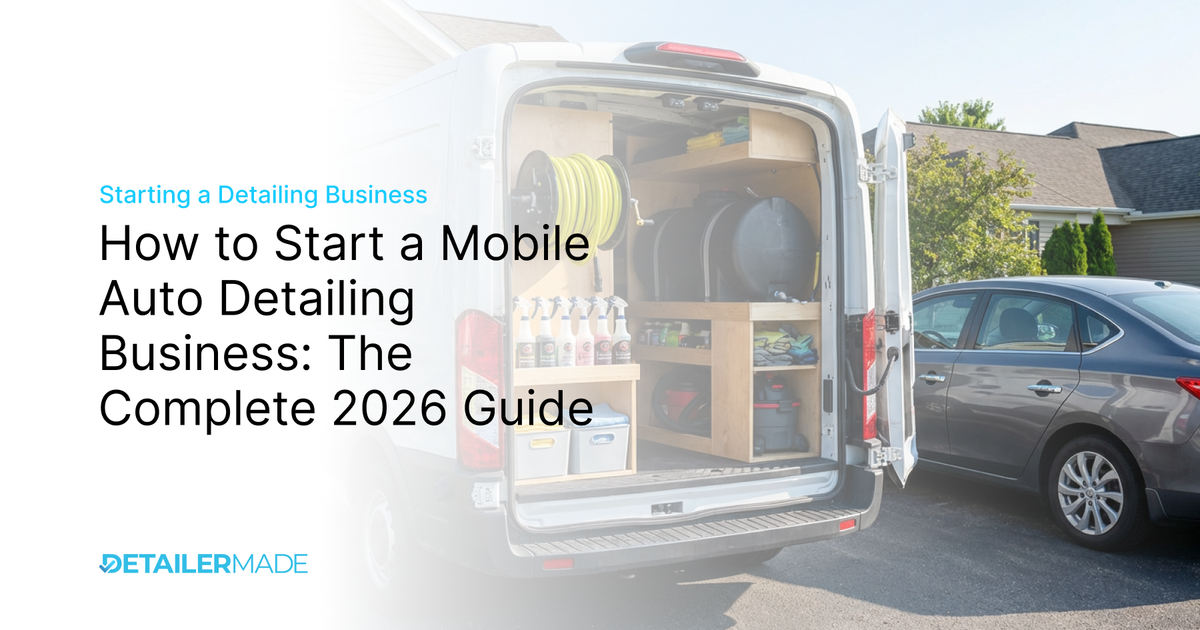
Organization makes or breaks mobile efficiency. Every minute spent hunting for a product or untangling hose is money lost. The basics that make a real difference: shelving or rack system along one or both walls (wire shelving is cheap to start; purpose-built van storage is better long-term), dedicated product zones grouped by use category (wash chemicals, interior chemicals, protection, tools), a hose reel or hose management system, a secure mount for the pressure washer so it doesn't shift in transit, and cable management for electrical equipment.
Keep the van clean and organized. A chaotic van communicates disorganization to clients even if the detail work is immaculate. First impressions start before you open the back doors.
Water Supply
A water tank is essential unless every job comes with a reliable outdoor spigot — which they often don't. Most mobile detailers run a 50–150 gallon tank fed by an on-board pump. Source from home before each work day or find a commercial fill station (some car washes, water fill stations, RV parks). Track your consumption per service type. A full exterior detail on a large SUV uses 15–25 gallons depending on equipment and process. Running dry mid-job is a real problem.
Licensing, Registration, and Business Structure
Register your business name (DBA or LLC depending on your state and preference), obtain a local business license from your city or county, and get an EIN from the IRS if you're operating as a business entity. This process takes a few hours and costs less than $200 in most states.
LLC vs. sole proprietor: an LLC creates liability separation between your personal assets and your business. For a service business where you're working on expensive client vehicles, that protection is worth the $50–$150 annual filing fee in most states. A single claim on a high-end vehicle could expose your personal finances if you're operating as a sole proprietor without protection.
Insurance: Not Optional
You need at minimum: • General liability: covers property damage and bodily injury caused by your business operations. Carry $1–2 million in coverage. Cost: $400–$900/year. • Garage keepers liability: covers damage to client vehicles while in your care, custody, or control. This is the "I scratched their car" coverage. General liability alone does not cover this. Cost: $500–$1,200/year. • Commercial auto: your personal auto policy will not cover the van when used for business. If you're in an accident driving to a job, a personal policy can deny the claim. Commercial auto covers business use. Cost varies by vehicle and coverage.
Find an insurer who understands service businesses — specifically detailing. Not every general insurer knows what garage keepers liability is. Look for specialty small business insurers or detailing-specific insurance brokers.
Building Your First Service Menu
Start with three services. Exterior wash and protect, interior detail, and a full detail combining both. That's enough to launch, build reviews, and start generating revenue. Add paint correction and coating services once you have the skills and equipment to deliver them confidently. Trying to offer advanced services before you've practiced them on client vehicles ends badly — your most expensive jobs should not be where you're learning.
Price every service before you launch. Know your costs. If you haven't run the pricing math, read the pricing guide and do it before you quote a single client.
Finding Your First Clients
Personal network first: friends, family, neighbors, former coworkers. Tell everyone you're launching. These early jobs build your portfolio — photograph every one of them.
Google Business Profile: Set this up before launch. It's free, and it's the single most important local SEO asset a mobile detailer has. Fill out every field completely. Start collecting reviews from your first clients immediately and respond to every one.
Nextdoor and local Facebook groups: A genuine post introducing your business with before/after photos gets real traction in local community groups. This is free and effective for a new operation with no ad budget.
Instagram: Set up the account before you launch and start posting. Before/after content, process videos, and client work. Local hashtags and geotags matter for discovery. Build this from day one consistently — it compounds over time in a way that paid lead services don't.
Don't buy leads from Thumbtack or Angi until you have reviews and a real portfolio. You'll lose on price to established operators and burn money chasing clients who chose you only because you were cheapest.
Scheduling and Invoicing Tools
Managing bookings by text and invoicing by Venmo works for 5 clients. At 15+ clients it becomes disorganized and looks unprofessional. Use software from the start. Tools like Urable, Jobber, or HouseCall Pro are built for mobile service businesses — they handle online booking, automated appointment reminders, invoicing, and payment processing. Urable is purpose-built for detailers and handles package quoting and recurring client management particularly well. Cost: $50–$100/month, which is cheap relative to the time it saves and the professional impression it creates.
Accept credit cards from day one. Not accepting cards loses you jobs. Whatever payment processing is built into your booking software works fine.
The Mistakes That End New Mobile Detailing Businesses
Underpricing: The most common mistake, by a wide margin. Calculate your costs and price above them. Every job priced below your true cost is a loss, even if it doesn't feel like one yet.
Not photographing jobs: Before-and-after photos are your marketing engine. Every job is content. Shoot them consistently from day one. You can't go back and reshoot a car you detailed six months ago.
Taking on work beyond your skill level: Booking a two-stage paint correction job before you've practiced the process properly ends with an unhappy client and a reputation problem. Build the skills first, then sell the service.
Skipping insurance: One claim — a scratch on a $80,000 car, a theft off your worksite, an accident in the van — is all it takes to understand why this wasn't optional. The annual cost of proper coverage is a rounding error compared to the exposure of operating without it.
Treating it like a hobby: The detailers who build real businesses treat the business side as seriously as the detail side. Pricing, scheduling, communication, bookkeeping, marketing — all of it matters. The technical skills get you started. The business skills determine whether you're still operating in three years.