Loading...
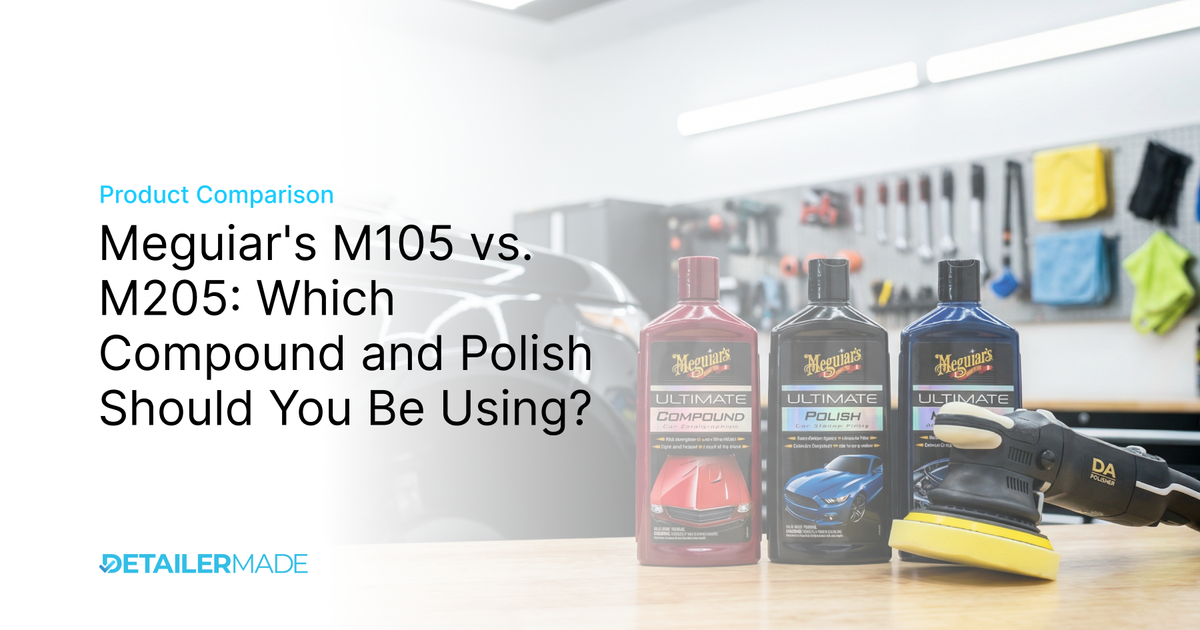
Meguiar's M105 vs. M205: Which Compound and Polish Should You Be Using?
JD
Detailermade Team
Ask most working detailers what compound and polish they reach for first and M105 and M205 will be in the answer. Meguiar's has been a professional shop staple for decades, and these two products sit at the core of a two-stage correction system that works reliably across a wide range of paint types. They're not the flashiest options on the shelf, but they're consistent, widely available, and well understood.
The question detailers actually ask isn't which one is better — it's which one they reach for and when. For most correction jobs, the answer is both.
M105: The Cutter
M105 is Meguiar's Ultra-Cut Compound. It uses diminishing abrasives — particles that start aggressive and break down progressively as they work — but it starts with genuine cutting power. On a cutting pad with a DA polisher, M105 cuts through moderate to heavy swirl marks, water spot etching, light oxidation, and shallow random isolated deep scratches (RIDS) effectively. On a rotary with a heavy cutting pad, it's capable of removing significant paint defects in a fraction of the time softer compounds would require.
What M105 does well: it cuts fast, it works across a wide range of paint types without being excessively aggressive on softer paint, and it cleans up reasonably well for a compound — meaning it doesn't leave the kind of heavy micro-marring that requires four or five finishing passes to address. Residue wipes off cleanly when properly worked out.
Where M105 has limits: it doesn't leave a finish-ready surface on most paint, especially on dark colors and harder clear coats. There will be micro-marring and light compounding haze visible under proper inspection lighting after an M105 pass. That's not a flaw — it's how cutting compounds function. The M205 finishing step is what removes those. The mistake is treating M105 as a one-and-done product on correction jobs where appearance matters.
Pad pairings: Meguiar's DHCD4 Microfiber Cutting Disc on a DA significantly amplifies M105's cut — this combination can handle correction that used to require a rotary. Standard medium or heavy foam cutting pad on a DA for more controlled cutting. Heavy cutting pad on a rotary when maximum cutting efficiency is needed on hard paint.
M205: The Finisher
M205 is Meguiar's Ultra Finishing Polish. The abrasive is substantially finer than M105 — M205 is designed to refine the surface left by a cutting compound, remove micro-marring and compounding haze, and leave a high-gloss, inspection-ready finish. It can also be used solo as a one-step on paint that only needs light correction or gloss enhancement — not full cutting.
What M205 does well: exceptional finishing ability, very low dusting compared to most finishing polishes, and it leaves a clean surface that's ready for coating, sealant, or wax without needing multiple follow-up passes. It also has enough cut to handle light swirl marks on its own on softer paint, which makes it genuinely useful for maintenance correction work and new car prep where full cutting isn't needed.
Where M205 has limits: it will not cut through moderate to heavy defects efficiently. Trying to remove deeper swirl marks with M205 alone is a slow, frustrating process that often still leaves the defects because the abrasive doesn't have the cut to level them. If M205 alone isn't fully removing defects after a proper test spot, you need M105 in the equation. Using the wrong product for the wrong job wastes time and leaves clients disappointed.
Pad pairings: Meguiar's DHFP5 Microfiber Finishing Disc on a DA for a clean, refined finish. Soft foam finishing pad for standard finishing work. On harder European paint, a medium finishing pad gives M205 slightly more mechanical action without changing the abrasive — useful when the cutting pass was done on hard paint and the finishing needs a little more help.
The Two-Step Process: How They Work Together
The M105 + M205 sequence is one of the most widely used two-stage correction processes in the industry. It's reliable, it's efficient on most paint types, and the products are available everywhere.
Step 1 — Cut with M105 on a cutting pad: Work panel by panel, 3–4 overlapping passes over each section at medium speed. You're removing the bulk of the defects. Work the compound until it breaks down — you'll see the residue lighten and the lubricity change. Wipe off cleanly with a quality microfiber. Inspect each section under a light before moving on. Confirm the defects are actually gone before you start finishing.
Step 2 — Finish with M205 on a finishing pad: Work the same panels, 2–3 passes. You're refining the surface left by M105 — removing the micro-marring and compounding haze, bringing the paint to a final high-gloss finish. Work at a slightly lower speed than M105 for maximum gloss output. Inspect again under proper lighting when done.
The full sequence on a mid-size sedan with moderate correction needs takes approximately 6–9 hours depending on paint hardness and defect severity. On harder European paint (BMW, Mercedes, Porsche), both stages run slower and sometimes need slightly more aggressive settings. On softer Japanese paint, both stages move faster but require careful speed management to avoid introducing new marring.
When to Use M205 Solo
M205 by itself makes sense for: • Light swirl removal and paint enhancement on a car with good overall condition • Maintenance correction on a previously corrected or coated car that's accumulated light surface marring • New car prep when the paint only needs refinement and decontamination before coating — no cutting required • Final refinement and spot-checking after M105 to confirm finish quality before coating application
When the goal is enhancement rather than correction, M205 solo on a finishing pad is one of the fastest, cleanest ways to get there.
When to Use M105 Solo (And When Not To)
M105 as a one-step makes sense for fleet recon and dealer reconditioning work — jobs where the goal is paint restoration and protection, not concours-level correction. Apply M105, refine minimally, apply a quick sealant, move on. Functional and fast.
Where you don't want M105 solo: any job ending in a high-end ceramic coating install. The micro-marring left by M105 needs to be refined out before applying a coating. Coating over M105 marring seals those marks in permanently — and under the enhanced gloss of a quality ceramic coating, they'll be visible. Don't skip the finishing pass on coating prep jobs. It's the difference between a result the client brags about and a result they come back about.
Common Mistakes With Both Products
Using too much product: More is not more. A pea-sized amount per section for M105, slightly more for M205 on a dry finishing pad. Excess product wastes material, flings off the pad, and makes residue removal significantly harder. Start with less than you think you need.
Working too large a section: Both products perform best in 16"×16" to 24"×24" sections. Work larger and the product starts flashing before you've properly worked it. Smaller sections give more control and more consistent results across the panel.
Not checking work under proper lighting: Swirl marks and micro-marring look completely different under a shop fluorescent versus a dedicated inspection light. After every panel, check under a direct, raking light source. Don't begin the finishing stage until you've confirmed the cutting stage actually removed the defects.
Skipping M205 because the paint "looks good enough" after M105: It rarely is. On black, dark blue, and dark grey paint especially, M105 micro-marring is clearly visible under proper lighting. The finishing step is what separates a correction job from a polished job. Take the extra time — it's what the client is paying for.