Loading...
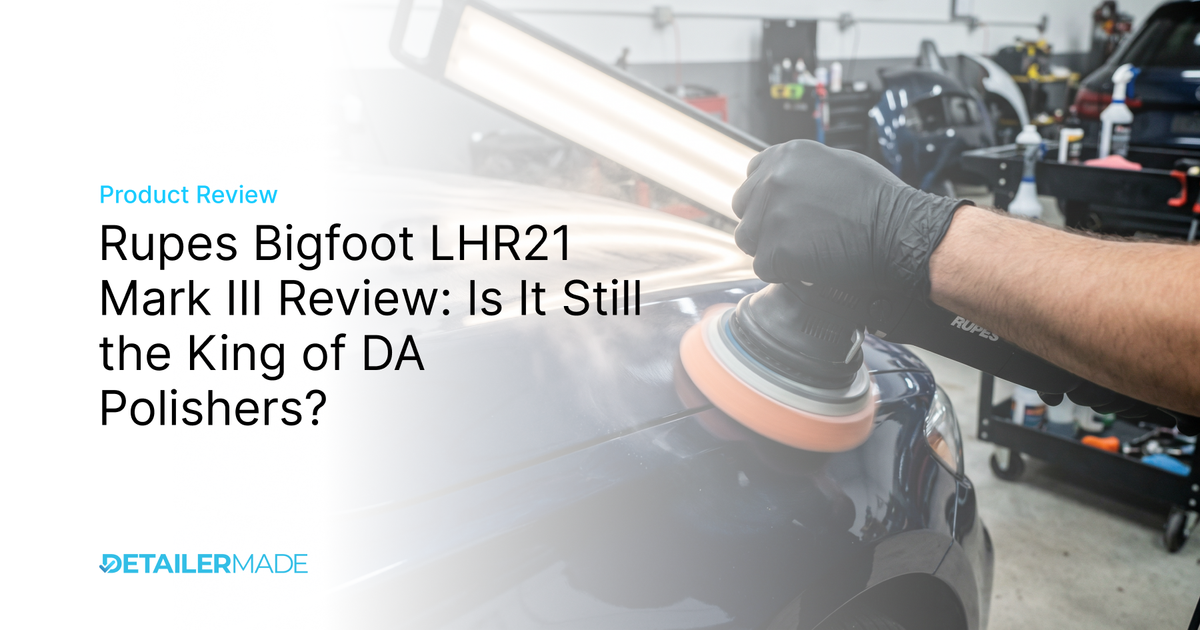
Rupes Bigfoot LHR21 Mark III Review: Is It Still the King of DA Polishers?
JD
Detailermade Team
The Rupes Bigfoot LHR21 has been the benchmark DA polisher for professional detailers for over a decade. The Mark III is the current iteration. For detailers considering the investment or wondering whether an upgrade from a previous generation makes sense, this is a practical look at what's changed, what it does well, and where it falls short.
What's New in the Mark III
The Mark III brought meaningful updates over the Mark II: • Revised motor with more consistent torque delivery under load — earlier Rupes models had noticeable speed loss under heavy correction pressure • Updated ergonomics: new grip profile that's noticeably more comfortable over a full-car correction session • Reduced vibration at the grip compared to Mark II — measurable over a long day • Revised speed dial placement that's more accessible during operation • Updated ventilation that runs cooler during extended sessions • Compatible with the full range of existing Rupes pads and third-party 5"/6" pads
Core specs unchanged: 21mm throw, variable speed 3,000–4,200 OPM, 500 watt motor.
Ergonomics and Vibration
This is where the Mark III earns real points over its predecessors. The handle redesign matters for professionals spending 6–10 hours on a correction job. Reduced vibration at the grip is noticeable — the older models transmitted more vibration into the hand, and over a full correction session that difference shows up in hand fatigue and grip quality at hour eight.
Balance is also improved. The Mark III feels slightly more front-weighted, which helps on flat panels where you want the machine's weight doing the work rather than actively pressing. More intuitive for operators who've learned not to force the machine.
Cutting Ability
Paired with a microfiber cutting disc (Rupes Coarse MF or Meguiar's DHCD4) and M105 or Koch Chemie H8.02, the LHR21 Mark III handles correction that used to require a rotary on soft to medium-hardness paint. On genuinely hard paint — hard European clear coats, some OEM formulations — it corrects but slower than a rotary. The 21mm throw gives it real mechanical advantage over 15mm DA polishers; that's the meaningful gap in the DA category.
Head-to-Head Comparisons
vs. Flex XFE 15-150: The Flex runs forced rotation that prevents pad stall under load — slightly more consistent cutting on very hard paint. The LHR21 Mark III edges it on ergonomics and finishing behavior. Both are genuinely professional machines. This comes down to preference and paint type.
vs. Griot's Garage G9: The G9 runs a 21mm throw and performs very well at a significantly lower price point. For detailers who can't justify the Rupes premium, the G9 is the strongest value DA available. The Mark III edges the G9 on motor feel, finish quality, and long-session comfort — but the gap is smaller than the price difference suggests.
vs. Milwaukee M18 Cordless: Not a direct competitor for primary correction work. The Milwaukee's cordless format is genuinely useful for finishing passes, panel work in tight spaces, and maintenance polish on coated cars. For heavy correction: use a corded machine.
Durability
Rupes has a strong reliability track record among professional users. The Mark III is built for daily professional use. Maintenance to stay on top of: backing plate inspection and replacement every 6–12 months of heavy use, cord inspection, and speed calibration if OPM starts drifting. Motor is serviceable and parts are available. This isn't a disposable tool.
Is the Premium Price Justified?
At $350–$420 retail, the LHR21 Mark III is among the most expensive single DA polishers available. The honest answer:
Professional shop running daily correction work: yes, unambiguously. Ergonomics over a full session, motor consistency, and finishing behavior justify the premium when the machine is your livelihood.
Serious enthusiast doing 10–15 cars a year: the G9 at roughly 40% of the price delivers 85–90% of the performance. The Mark III is better, but not $200 better for that use case.
Comparing to $60–$100 DA polishers: different category entirely. Machine quality at this level is about motor consistency, ergonomics, and durability under real correction loads — not brand loyalty.
Final Verdict
The Rupes Bigfoot LHR21 Mark III is still the professional benchmark for DA polishers in 2026. The Mark III improvements are real, not marketing refreshes. If you're in the market for a flagship DA and cost isn't the deciding factor, this is still the machine to buy. If budget matters, the G9 is the next best call. If you're doing hard paint regularly, complement whatever DA you own with a rotary — the two tools together cover everything.