Loading...
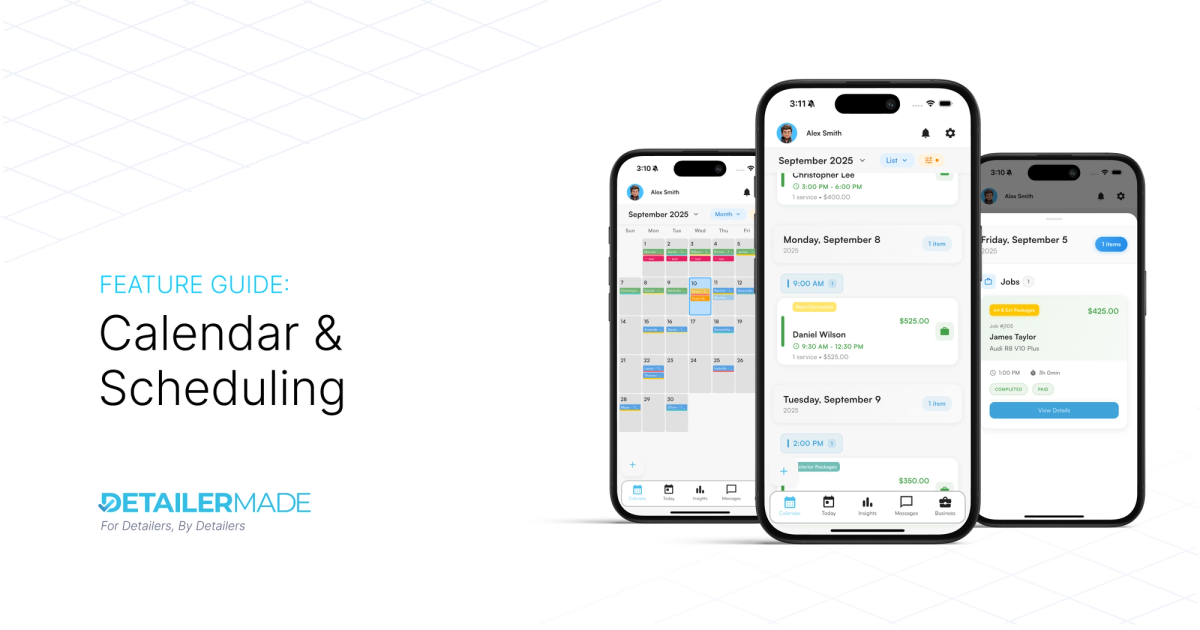
Calendar & Scheduling
JD
Caleb B.
Co-Founder & Lead Developer

Calendar Views
Customize how you view your schedule with four different calendar layouts. Choose the view that works best for how you plan your day.
Changing Calendar Views
Two Ways to Change Views:
- From Calendar Header - Tap the blue "Month" dropdown at the top of the calendar
- From Settings - Tap the settings icon → Calendar → Default Calendar View
Your selected view persists, so you only need to set it once.
Available Views
Month View
- See your entire month at a glance
- Jobs displayed as colored blocks on their scheduled dates
- Perfect for long-term planning and availability overview
Week View
- Focus on a single week
- More detail on each day's schedule
- Ideal for weekly planning
List View
- Chronological list of all upcoming jobs
- Shows complete job details in order
- Best for task-focused scheduling
Day View
- Single day focus with hourly breakdown
- Most detailed view of your daily schedule
- Perfect for managing a busy day
Calendar Settings
Hide Cancelled Appointments
- Toggle on to remove cancelled jobs from your calendar view
- Keeps your schedule clean and focused on active bookings
- Cancelled jobs are still accessible in job history
Quick Tip: Jobs appear in their service category colors, making it easy to identify service types at a glance. Set these colors when creating your service categories. Learn more about service categories

Calendar Filters
Customize what jobs appear on your calendar with quick filters accessible from the calendar header.
Access Filters: Tap the filter/preferences icon (grid icon) in the calendar header to open the Filter Jobs dialog.
Filter Options:
Hide Cancelled Jobs
- Toggle on to remove cancelled jobs from your calendar
- Keeps your view focused on active bookings
- Cancelled jobs remain in your job history
Assignment Status Choose which jobs to display based on team assignment:
- All Jobs - Show all jobs regardless of assignment (default)
- Assigned Jobs - Show only jobs with assigned teams
- Unassigned Jobs - Show only jobs without assigned teams
Why This Matters:
Filters help you focus on what's relevant. If you need to assign teams, view only unassigned jobs. If you want to see your crew's workload, view only assigned jobs. If you're planning overall capacity, view all jobs.
Your filter selections apply instantly to the calendar view, making it easy to switch between different perspectives of your schedule.
Managing Your Schedule
Your Base Schedule (Business Hours)
Your base schedule defines your default weekly availability — the hours you're open for bookings each day of the week.
Example:
You're a mobile detailer and you work Monday–Friday, 9:00 AM – 5:00 PM. You set each of those weekdays to enabled with a start time of 9:00 AM and end time of 5:00 PM. Saturday and Sunday are toggled off — no one can book those days.
This repeats every week automatically. You set it once and it drives your entire calendar.
Time Windows (Split Schedules)
Need a break in the middle of your day? Time windows let you split a day into multiple blocks.
Example:
You want to take lunch from 12:00 PM – 1:00 PM every Wednesday. Instead of one block from 9–5, you set up:
- Base hours: 9:00 AM – 12:00 PM
- Window: 1:00 PM – 5:00 PM
Now no one can book a job that overlaps your lunch hour on Wednesdays.
You can add as many windows as you need. If you only work mornings and evenings on Fridays, set up two windows and leave the afternoon empty.
Concurrent Jobs (Slots)
This controls how many jobs can overlap at the same time. It defaults to 1 — meaning only one booking per time slot.
Example — Solo operator:
You set max concurrent jobs to 1. If someone books 10:00 AM – 12:00 PM, that entire block is unavailable to anyone else.
Think of it as the number of jobs your business can physically handle at once.
Buffer Time
Buffer time adds a cooldown period after every job before the next one can start. This gives you travel time, cleanup, or a breather.
Example
You set a 30-minute buffer and offer a 2-hour service. A customer books 9:00 AM – 11:00 AM. The next available slot won't start until 11:30 AM, not 11:00 AM.
Customers never see the buffer — it just quietly protects your time between jobs.
Overrides (Custom Days)
Overrides let you change the rules for a specific date, without touching your weekly schedule.
Closing a Day
Need a day off that isn't a regular holiday? Close it entirely.
Example
You're normally open on Thursdays, but April 10th you have a personal appointment. You add an override for April 10th and mark it as closed. That date shows zero availability — no one can book it. Every other Thursday is unaffected.
Custom Hours
Want to work a shorter or longer day on a specific date?
Example
You're normally open 9–5 on Mondays, but next Monday you need to leave early for your kid's game. You add an override for that Monday with hours of 9:00 AM – 2:00 PM. Only that one Monday changes — every other Monday stays 9–5.
Example
A big local event is happening Saturday and you want to open up for it, even though Saturdays are normally off. You add an override for that Saturday with hours of 8:00 AM – 3:00 PM. You're now bookable for that one Saturday only.
Restricting Slots on a Specific Day
Normally run 2 concurrent jobs but need to scale down for a day?
Example
One of your crew members is out sick on Tuesday. You normally allow 2 concurrent jobs. You add an override for that Tuesday and set slots allowed to 1. Customers can still book, but only one at a time. Your other Tuesdays remain at 2.
Events
Events represent blocks of time on your calendar that aren't customer bookings. There are two types:
Non-Bookable Events (Block Time)
These consume your availability just like a real job would.
Example
You have a staff meeting every Monday from 12:00 PM – 1:00 PM. You create a non-bookable event for that time. It eats into your available slots the same way a customer booking does — if you only allow 1 concurrent job, that hour is fully blocked. If you allow 2, it takes up one of them.
Example
You need to pick up supplies Wednesday from 3:00 PM – 4:00 PM. Add a non-bookable event. That time is now protected from bookings.
Use non-bookable events for anything that takes up your working capacity: meetings, errands, equipment maintenance, training.
Bookable Events (Informational)
These sit on your calendar for your own reference but do not reduce availability.
Example
You have a networking event Friday evening. You add it as a bookable event so it shows on your calendar, but since it's outside your business hours, it doesn't matter. Even if it overlapped your hours, it wouldn't block any slots — it's just a visual reminder.